
Shared memory for multi-agent systems
Wolbarg
Durable shared memory for AI agents. Remember once, recall by meaning across sessions, tools, and multi-agent workflows. try our coding agents for cursor, codex and claude code below
$ npm install wolbargAdd persistent memory to:
One agent records a decision · every connected agent loads it next
Why it exists
Coding agents forget. Shared state gets messy.
Cursor, Claude Code, and Codex drop context when a session ends. Multi-agent setups invent shared state with chat transcripts, globals, or Redis — then lose semantic search, concurrency, and crash safety.
Without Wolbarg
- Every session re-explains the same architecture
- Decisions made in Cursor never reach Claude or Codex
- Notes pile up instead of staying current
- No semantic search across what agents learned
- Concurrency and crash safety are DIY
With Wolbarg
- Workspace keeps one reconciled project briefing
- Hosts share decisions, tasks, bugs, and constraints
- Stale facts get superseded — not duplicated
- SDK gives builders durable semantic memory
- Local-first SQLite by default, Postgres when you need it
Wolbarg Workspace
The product for coding agents
Install once per repository. Connect the hosts you use. Every agent starts informed and leaves the workspace more useful for the next one.
Wolbarg Workspace
@wolbarg/workspace
Shared, reconciled project truth for Cursor, Claude Code, and Codex. Agents stop re-explaining the codebase every session.
$ npx @wolbarg/workspace initWhat you get
Shared across hosts
Cursor, Claude Code, and Codex read and write the same project truth.
Reconciled, not appended
Updates replace stale facts instead of piling up notes.
Evidence-backed
Decisions and discoveries stay tied to files, tests, and docs.
One CLI
init, connect, doctor, status, review — no hand-edited MCP JSON.
Connect with connect cursor, connect claude, or connect codex.
How it works
One agent writes. Every agent can find it.
Under Workspace and custom agents, the same SDK path applies: store what agents learn as vectors, keep the original text, and let siblings search by meaning.
Step 1
Agent remembers
One agent calls remember() with a fact and optional metadata.
Step 2
Embedding generated
content.text is embedded through your OpenAI-compatible endpoint.
Step 3
Written to shared memory
Original text, metadata, and vector land in the shared store.
Step 4
Another agent recalls
A different agent asks in natural language and gets ranked hits.
Connectors
Plug shared memory into where agents already run
Workspace connects coding agents. AI SDK adapters cover custom agent frameworks on the same Wolbarg memory layer.
Wolbarg Workspace
@wolbarg/workspace
Shared, reconciled project truth for Cursor, Claude Code, and Codex. Agents stop re-explaining the codebase every session.
$ npx @wolbarg/workspace initWhat you get
Shared across hosts
Cursor, Claude Code, and Codex read and write the same project truth.
Reconciled, not appended
Updates replace stale facts instead of piling up notes.
Evidence-backed
Decisions and discoveries stay tied to files, tests, and docs.
One CLI
init, connect, doctor, status, review — no hand-edited MCP JSON.
Connect with connect cursor, connect claude, or connect codex.
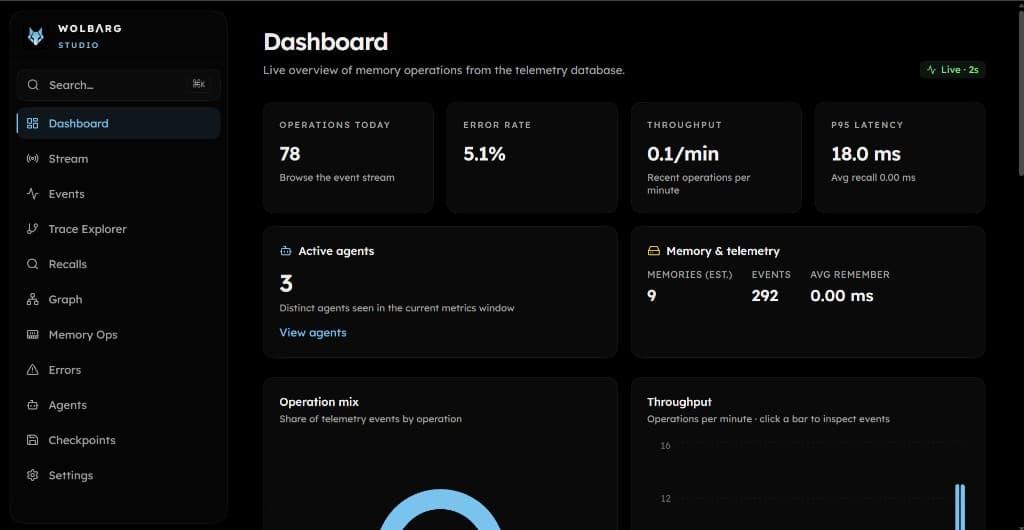
Wolbarg Studio
See what memory is doing
Wolbarg Studio is the local observability UI for your telemetry database — live ops and Trace Explorer waterfalls. Enable telemetry in the SDK, open Studio, and debug without a hosted control plane.
- Live dashboard — throughput, errors, P95 latency
- Trace Explorer — embedding → search → ranking spans
- Local telemetry DB — no hosted control plane
Core features
Built for real multi-agent systems
Shared by design
Multiple agents write and read the same memory. Concurrency and durable writes are built in — not bolted on.
Reconciled project truth
Workspace replaces stale facts instead of appending notes. Decisions stay current across sessions.
Semantic recall
Agents ask in natural language. Wolbarg embeds the query and returns the closest memories by meaning.
Multi-agent systems
Planners, workers, and reviewers share one knowledge plane instead of passing brittle context by hand.
Coding-agent hosts
Connect Cursor, Claude Code, and Codex with one CLI. SDK adapters cover Vercel AI, LangChain, and more.
Tiny SDK API
remember, recall, compress, forget, history, stats. Easy to drop into an existing agent loop.
No memory SaaS lock-in
You own the store and the providers. Swap embeddings, backends, and connectors without rewriting agents.
Performance
Benchmarked for real agent workloads
Historical storage suite from Wolbarg 0.4 (mock embeddings) — dual-backend, full SDK path, reproducible in-repo. Storage (mock) ≠ LIVE (real providers).
SQLite bulk insert @ 2k
7.51k/s
Historical · Wolbarg 0.4 mock stress suite
SQLite recall p95 @ 2k
4.83 ms
Historical · v0.4 storage suite · mock embeddings
SQLite 16 writers
8.66k/s
Historical · v0.4 same-process concurrency
Embedding cache
90% fewer calls
Historical · v0.4 repeated-ingest microbench
PG bulk insert @ 2k
4.08k/s
Historical · v0.4 local Postgres + pgvector
Same workloads across supported backends. Pick the deployment that matches your system — numbers stay honest.
Feature comparison
✅ Supported · ⚠️ Partial · ❌ No · ❓ Unknown. No invented competitor timings.
| Feature | Wolbarg | Mem0 | Zep | Letta | LangGraph Memory | LlamaIndex | Mastra | Chroma | Qdrant | Weaviate |
|---|---|---|---|---|---|---|---|---|---|---|
| Local-first / offline | ✅ | ⚠️ | ⚠️ | ⚠️ | ⚠️ | ⚠️ | ⚠️ | ✅ | ⚠️ | ⚠️ |
| Native SQLite | ✅ | ⚠️ | ❌ | ⚠️ | ⚠️ | ⚠️ | ⚠️ | ⚠️ | ❌ | ❌ |
| Native PostgreSQL | ✅ | ⚠️ | ⚠️ | ⚠️ | ✅ | ⚠️ | ⚠️ | ❌ | ❌ | ❌ |
| Hybrid keyword + vector | ✅ | ⚠️ | ✅ | ❓ | ❓ | ✅ | ❓ | ⚠️ | ✅ | ✅ |
| Write-time dedupe / upsert | ✅ | ⚠️ | ⚠️ | ❓ | ❌ | ⚠️ | ❓ | ⚠️ | ⚠️ | ⚠️ |
| Real-time change events | ✅ | ⚠️ | ⚠️ | ❓ | ❌ | ❌ | ❓ | ❌ | ⚠️ | ⚠️ |
| Embedding cache | ✅ | ❓ | ❓ | ❓ | ❓ | ⚠️ | ❓ | ❌ | ❌ | ❌ |
| Multi-writer concurrency hardening | ✅ | ❓ | ❓ | ❓ | ⚠️ | ❓ | ❓ | ⚠️ | ✅ | ✅ |
| Open source | ✅ | ✅ | ⚠️ | ✅ | ✅ | ✅ | ✅ | ✅ | ✅ | ✅ |
| Public reproducible storage benchmarks | ✅ | ❌ | ❌ | ❌ | ❌ | ❌ | ❌ | ⚠️ | ✅ | ✅ |
Start with Workspace
Give Cursor, Claude Code, and Codex one durable project memory — or build on the Wolbarg SDK for custom agents.